“WE CHOSE TO GO TO THE MOON” TO PREMIERE ON PBS ON TUESDAY, NOVEMBER 10
Press Contacts for American History Unbound:
Rick Miramontez / Michael Jorgensen
rick@omdkc.com / michael@omdkc.com
212 695 7400
Press Contacts for PBS:
Atiya Frederick, PBS / Jordan Lawrence, DKC
anfrederick@pbs.org / jordan_lawrence@dkcnews.com
FOR IMMEDIATE RELEASE, PLEASE
AMERICAN HISTORY UNBOUND’S
ACCLAIMED PRODUCTION
“WE CHOSE TO GO TO THE MOON”
PREMIERES
TUESDAY, NOVEMBER 10, 2026
ON
PBS, PBS.ORG, AND THE PBS APP
SPECIAL THEATRICAL EVENT
FOLLOWS AMERICA’S DRAMATIC RACE TO SPACE THROUGH THE PERSONAL STORIES OF THE ASTRONAUTS, ENGINEERS AND THEIR FAMILIES, SOUNDTRACKED BY SOME OF THE MOST ENDURING MUSIC FROM THE ERA
CREATED AND NARRATED BY WRITER AND HISTORIAN JOHN MONSKY
DIRECTED FOR THE STAGE AT CARNEGIE HALL
BY TONY AWARD-WINNER MICHAEL MAYER
PRODUCED FOR TELEVISION BY ACADEMY AWARD-WINNING RADICALMEDIA
Arlington, VA (July 23, 2026) – PBS announced We Chose To Go To The Moon, a new “living documentary” about an iconic moment in history, America’s space race. Blending live music and storytelling in a vivid on-stage experience, this special theatrical event will premiere Tuesday, November 10, at 8:00 p.m. ET (check local listings) on PBS, PBS.org, and the PBS app on the eve of Veterans Day on November 11th.
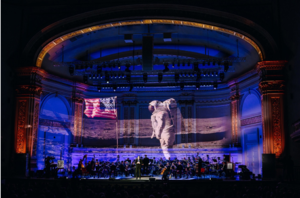
Created, written and narrated by writer and historian John Monsky and directed for the stage by Tony Award winner Michael Mayer (Spring Awakening, Chess), this immersive theatrical experience tells the dramatic tale of America’s race to space and decision to land a man on the Moon in one of the most ambitious scientific and exploration achievements in history. Bringing together a 45-piece orchestra and band – including a rare theremin – along with Broadway vocalists, breathtaking photographs, and narrative drama, the production creates an emotional history unlike any previous telling of mankind’s journey to the Moon. The program features flags that have traveled to the Moon and back and have witnessed some of our nation’s most emotional and patriotic moments, making history themselves.
Filmed at Carnegie Hall in April 2026 by the Academy Award-winning RadicalMedia, against the backdrop of the Artemis II mission around the Moon, We Chose To Go To The Moon includes vignettes and vocal performances by stage and film star Skylar Astin (Pitch Perfect, Spring Awakening), Grammy Award nominee Brent Comer (The Outsiders), Claybourne Elder (Company, “The Gilded Age”), TV star Elizabeth Gillies (Netflix’s “Dynasty”), Tony Award nominee Taylor Louderman (Mean Girls), and Grammy and Tony Award-nominee Joy Woods (Gypsy, Six). Neil Armstrong’s son Mark Armstrong and granddaughter Kali Armstrong also perform a moving special tribute to the astronaut.
Monsky tells the story through the perspectives of the people who lived through this extraordinary moment – astronauts Neil Armstrong, Buzz Aldrin, Michael Collins, and Ed White; the everyday Americans who got the rockets off the ground including Mission Control trailblazer Poppy Northcutt and NASA’s “Hidden Figures” mathematician Katherine Johnson; and the families behind America’s ambitious space program such as Janet Armstrong and Betty Grissom. We Chose To Go To The Moon transports audiences from quaking launch pads at Cape Canaveral to the tension-filled rooms of Mission Control and into the living rooms where families watched their loved ones disappear into the sky as the world watched history unfold in real time.
Set against a cultural soundtrack of music from the era, Ian Weinberger (Chess, Hamilton) conducts top Broadway vocalists and the Orchestra of St. Luke’s in music from the era—popular, patriotic, and protesting, including, “Fly Me to the Moon,” “Rocket Man,” “Space Oddity,” and “Sound of Silence.” The performance reaches a crescendo in the fulfillment of President John F. Kennedy’s 1961 challenge to land a man on the Moon and return him safely to Earth before the end of the decade.
The words of the astronauts, engineers, and their families recall the excitement, the fear, and the triumph of the race to space. In a poignant moment, viewers will see the three burial flags of the Apollo 1 astronauts brought together for the first time – a moving reminder that most of the astronauts were also American veterans.
“We are delighted to once again partner with American History Unbound and RadicalMedia to bring audiences an immersive new way to experience one of the defining achievements in American History, the race to put a man on the Moon,” said Zara Frankel, Senior Director, Programming and Development at PBS. “While the Apollo 11 mission inspired the world to look to the stars, this ‘living documentary’ reminds us that history is ultimately shaped through individual lives. As we approach Veterans Day, it’s especially poignant to honor the service, courage, and dedication of the veterans whose leadership helped to make one of humanity’s greatest accomplishments possible.”
“When future generations of Americans look back at the defining moments in history, I believe the Moon landing on July 20, 1969, will endure as one of our most important achievements,” said John Monsky. “We’re proud that this show airs timed to Veterans Day – nearly all the Apollo astronauts were veterans, and their legacy of service to our country is immeasurable.”
We Chose To Go To The Moon will stream simultaneously with broadcast and be available on all station-branded PBS platforms, including PBS.org and the PBS app, which is available on iOS, Apple TV, Android mobile and tablets, Android/Google TV, Roku, Amazon Fire TV and tablets, Comcast, Samsung Smart TV, VIZIO and LG Smart TVs.
Produced for television by RadicalMedia and for the stage by American History Unbound, the program’s creative team includes Executive Producers Jon Kamen, John Monsky, Dave Sirulnick, Meredith Wagner, and Karla Zambrano. The television production is directed by Michael John Warren and Michael Mayer directs for the stage. Ian Weinberger serves as music supervisor, conductor, and arranger. Declan Quinn serves as director of photography and Paul Little and Spencer Averick as editors. Stage lighting design by Mike Baldassari.
Major funding for We Chose To Go To The Moon was provided by Kenneth C. Griffin with Griffin Catalyst.
Additional funding for We Chose To Go To The Moon was provided by Screaming Comet Foundation, Brian Cherry through Cherry Family Fund, Peter and Katie O’Neill, Brett Shapiro and Kristen O’Neill, Tim Bass, Jerry Speyer and Katherine Farley, Barry and Nancy Barnett, Brown Brothers Harriman & Co., Carla Knobloch, Brian and Lori Schreiber, Daniel and Alisa Doctoroff, John Molner, and Robert and Lynn Ducommun.
ABOUT AMERICAN HISTORY UNBOUND
The American History Unbound series combines live music—performed by leading orchestras and celebrated Broadway actors—lecture, photographs and film from the National Archives, historic American flags, and material culture to explore watershed moments in American history.
These symphonic and visual journeys through history are commissioned by the Carnegie Hall Presents series. Created and narrated by historian John Monsky, programs to date have explored the Vietnam War, D-Day, and World War I.
These works have been presented at Carnegie Hall, Boston’s Symphony Hall, the John F. Kennedy Center Opera House, Miami’s New World Center, New Orleans’ Orpheum Theater, Jacksonville Center for the Performing Arts, The New York Historical, Parrish Art Museum in Water Mill, New York, Norton Museum of Art in West Palm Beach, Florida, Yale University, New York University’s Skirball Center for the Performing Arts, and the New York Stock Exchange. In December 2024, The Eyes of the World: From D-Day to VE Day was performed at the White House commemorating the anniversary of Pearl Harbor. A performance with the legendary Boston Pops is currently streaming via PBS Passport.
American Heart in WWI: A Carnegie Hall Tribute, filmed at Carnegie Hall in April 2025 by the Academy Award-winning RadicalMedia – Summer of Soul (…Or, When the Revolution Could Not Be Televised) – and directed for the stage by Tony Award-winner Michael Mayer (Spring Awakening), is currently streaming on PBS Passport, presented by Kenneth C. Griffin and Griffin Catalyst. American History Unbound Inc is a 501(c)(3). For more information, visit americanhistoryunbound.com
ABOUT PBS
PBS, with more than 330 member stations, offers all Americans the opportunity to explore new ideas and new worlds through television and digital content. Each month, PBS reaches over 36 million adults on linear primetime television, more than 16 million users on PBS-owned streaming platforms, 53 million viewers on YouTube, and 60 million people view PBS content on social media, inviting them to experience the worlds of science, history, nature, and public affairs and to take front-row seats to world-class drama and performances. PBS’s broad array of programs has been consistently honored by the industry’s most coveted award competitions. Teachers of children from pre-K through 12th grade turn to PBS LearningMedia for digital content and services that help bring classroom lessons to life. As the number one educational media brand, PBS KIDS helps children 2-8 build critical skills, enabling them to find success in school and life. Delivered through member stations, PBS KIDS offers high-quality content on TV — including a PBS KIDS channel — and streaming free on pbskids.org and the PBS KIDS Video app, games on the PBS KIDS Games app, and in communities across America. More information about PBS is available at PBS.org, one of the leading dot-org websites on the internet, Facebook, Instagram, or through our apps for mobile and connected devices. Specific program information and updates for press are available at pbs.org/pressroom or by following PBS Communications on X.
# # # #
americanhistoryunbound.com
instagram.com/amhistunbound/
www.omdkc.com
www.instagram.com/omdkc
www.facebook.com/omdkc